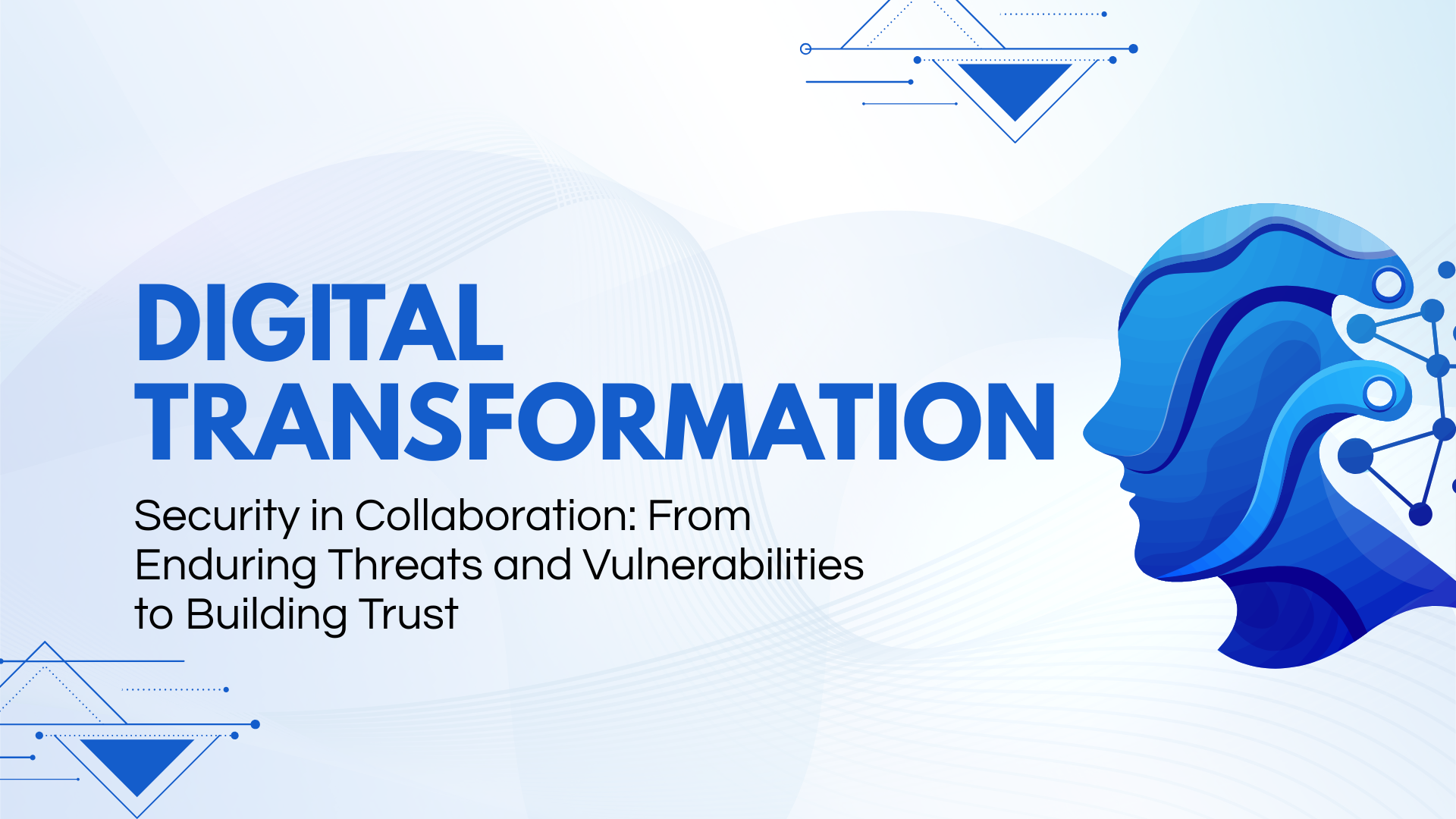
Explore how secure collaboration drives digital transformation. Learn about Zero Trust, governance, risk management, and IT advisory services in Virginia with expert insights from Tushar Hazra.
By exploring the perspectives of Tushar Hazra, Executive Enterprise Architect
In today's hyperconnected digital economy, collaboration has become the cornerstone of innovation, productivity, and business growth. Organizations rely on cloud platforms, hybrid work environments, third-party integrations, and cross-functional teams to accelerate decision-making and deliver exceptional customer experiences. However, with increased collaboration comes a growing concern: security.
For many IT leaders and business executives, there is a long-standing belief that greater collaboration inevitably weakens corporate security. Employees sharing files externally, remote access to corporate applications, cloud-based communication platforms, and vendor integrations often appear to expand the organization's attack surface.
But does collaboration truly require compromising security?
The answer is a definitive no.
Modern organizations no longer have to choose between collaboration and security. Instead, they must design environments where security becomes an enabler of collaboration rather than an obstacle.
This philosophy is championed by Tushar Hazra, an Executive Enterprise Architect with more than 22 years of experience in enterprise architecture, implementation, governance, risk management, compliance, and digital transformation. Throughout his career, Dr. Hazra has helped organizations develop enterprise-wide strategies, technology blueprints, governance frameworks, and transformation roadmaps that align innovation with security and business objectives.
His experience demonstrates that collaboration and security are not competing priorities—they are complementary pillars of digital success.
Understanding the Security-Collaboration Dilemma
Businesses today operate across multiple environments simultaneously.
Employees work remotely.
Partners access internal systems.
Customers interact through digital channels.
Applications run in multiple cloud providers.
Sensitive information moves constantly across organizational boundaries.
These realities have changed how organizations approach security.
Traditional security models assumed that everything inside the corporate network could be trusted. Once users authenticated themselves within the firewall, they often had broad access to systems and data.
That model no longer works.
Modern organizations require security that follows users, devices, applications, and data wherever they go.
Instead of limiting collaboration, organizations must secure collaboration.
Why Collaboration Expands the Attack Surface
Every collaborative technology introduces potential risks.
Examples include:
Cloud storage
Video conferencing
Team messaging
Shared documents
Third-party integrations
APIs
Mobile applications
Remote work environments
Vendor portals
Customer self-service platforms
Each connection represents another opportunity for attackers.
Cybercriminals increasingly target collaboration tools because they provide access to valuable corporate data and trusted communication channels.
Common attack vectors include:
Phishing campaigns
Credential theft
Ransomware
Insider threats
Data leakage
Supply chain attacks
Misconfigured cloud storage
Shadow IT
Social engineering
As organizations embrace digital transformation, these risks grow exponentially.
From Perimeter Security to Zero Trust
One of the most significant shifts in cybersecurity has been the transition from perimeter-based security to Zero Trust Architecture.
The principle is simple:
Never trust. Always verify.
Instead of assuming users inside the network are trustworthy, every request is continuously validated.
Zero Trust incorporates:
Identity verification
Multi-factor authentication
Device health checks
Least privilege access
Continuous monitoring
Behavioral analytics
Risk-based authentication
This approach enables organizations to collaborate freely while maintaining strict security controls.
Building Trust Through Enterprise Architecture
According to Tushar Hazra, enterprise architecture serves as the bridge between business goals and secure technology implementation.
Enterprise architecture provides:
Governance
Standardization
Technology alignment
Risk management
Strategic planning
Security integration
Rather than implementing isolated security solutions, organizations should embed security into every layer of enterprise architecture.
Security becomes part of:
Business architecture
Information architecture
Application architecture
Technology architecture
This integrated approach creates sustainable digital transformation.
Governance: The Foundation of Secure Collaboration
Governance is often misunderstood as bureaucracy.
In reality, governance provides consistency.
Without governance:
Teams adopt unauthorized tools.
Sensitive information becomes fragmented.
Compliance gaps emerge.
Security policies become inconsistent.
Effective governance establishes:
Clear ownership
Data classification
Access management
Policy enforcement
Audit capabilities
Compliance monitoring
Good governance empowers collaboration because employees understand how to work securely.
Identity Is the New Security Perimeter
Passwords alone are no longer sufficient.
Modern identity management includes:
Multi-factor authentication
Single sign-on
Adaptive authentication
Identity governance
Privileged access management
Organizations must know:
Who is accessing systems?
What are they accessing?
Why?
From where?
On which device?
This visibility dramatically reduces organizational risk.
Protecting Data Instead of Networks
In today's cloud-first environment, data moves continuously.
Traditional network boundaries disappear.
Therefore, organizations must secure data itself.
Data-centric security includes:
Encryption
Data Loss Prevention (DLP)
Rights management
Secure sharing
Classification
Labeling
Monitoring
When data remains protected regardless of location, collaboration becomes significantly safer.
Human Behavior Remains the Greatest Vulnerability
Technology alone cannot solve cybersecurity.
Employees continue to be the primary target for attackers.
Successful organizations invest heavily in:
Security awareness training
Phishing simulations
Executive education
Incident reporting
Cybersecurity culture
Security awareness transforms employees from vulnerabilities into active defenders.
Managing Third-Party Risks
Today's organizations rarely operate independently.
Suppliers, vendors, consultants, contractors, and partners all require access to corporate systems.
Every external relationship introduces additional risk.
Effective third-party risk management includes:
Vendor assessments
Security questionnaires
Continuous monitoring
Contractual security requirements
Access reviews
Compliance verification
Trust must be earned—not assumed.
Cloud Collaboration Without Compromising Security
Cloud adoption continues accelerating.
Cloud platforms provide tremendous advantages:
Scalability
Flexibility
Remote accessibility
Cost optimization
Faster innovation
However, organizations must understand the shared responsibility model.
Cloud providers secure infrastructure.
Customers secure:
Identities
Data
Configurations
Applications
Access controls
Misconfigured cloud environments remain one of the leading causes of data breaches.
AI and Automation in Cybersecurity
Artificial Intelligence is transforming cybersecurity.
Organizations increasingly leverage AI for:
Threat detection
Behavioral analytics
Security operations
Automated incident response
Vulnerability prioritization
Fraud detection
AI enables security teams to respond faster than human analysts alone.
However, attackers also use AI.
This creates an ongoing cybersecurity arms race.
Organizations must continuously evolve their defenses.
Compliance as a Competitive Advantage
Many organizations view compliance as a regulatory burden.
Forward-thinking businesses see compliance differently.
Strong compliance frameworks improve:
Customer confidence
Investor trust
Operational consistency
Risk reduction
Brand reputation
Frameworks such as ISO 27001, NIST, SOC 2, GDPR, HIPAA, and industry-specific standards provide structured approaches to cybersecurity governance.
Compliance supports business growth rather than limiting it.
Digital Transformation Requires Security by Design
Digital transformation initiatives frequently fail because security is introduced too late.
Successful organizations integrate security from the beginning.
Security by Design means considering security during:
Business planning
Application development
Infrastructure design
Cloud migration
Process automation
Data architecture
Embedding security early significantly reduces costs and implementation delays.
Solve IT Challenges with Strategic Consulting in Virginia
Organizations across Virginia are rapidly modernizing their technology ecosystems to remain competitive in an increasingly digital economy. Whether adopting cloud platforms, strengthening cybersecurity, improving compliance, or enabling enterprise-wide collaboration, businesses require more than technical support—they need strategic guidance that aligns technology investments with business objectives.
Strategic IT consulting helps organizations identify risks, modernize legacy systems, optimize enterprise architecture, and implement governance frameworks that support secure innovation. Experienced consultants evaluate current technology landscapes, develop practical roadmaps, and recommend solutions that improve resilience, operational efficiency, and long-term scalability.
By combining cybersecurity best practices with enterprise architecture, organizations can confidently pursue digital transformation while minimizing operational risk. Strategic consulting also supports regulatory compliance, business continuity planning, cloud migration, and technology governance, enabling companies to make informed decisions that deliver measurable business value.
Top IT Consulting Companies in Virginia - 2026
Virginia continues to be a major technology hub, home to organizations serving government agencies, healthcare providers, financial institutions, defense contractors, manufacturing companies, and rapidly growing startups. As digital transformation accelerates, businesses increasingly rely on IT consulting firms that offer expertise in cybersecurity, cloud computing, enterprise architecture, data analytics, artificial intelligence, governance, and digital modernization.
When evaluating an IT consulting partner in 2026, organizations should consider several key factors:
Proven experience delivering enterprise-scale transformation projects
Expertise in cybersecurity and risk management
Strong governance and compliance capabilities
Cloud strategy and migration experience
Enterprise architecture consulting
Digital transformation planning
Data governance and analytics
AI readiness and automation strategies
Transparent project management
Long-term strategic partnership capabilities
The right consulting partner should not only solve today's technology challenges but also help organizations prepare for future innovation, resilience, and sustainable growth.
IT Consulting Companies in Virginia (2026)
The IT consulting landscape in Virginia continues to evolve as organizations demand integrated solutions that combine business strategy with advanced technology expertise. Modern consulting firms provide services that extend beyond traditional infrastructure support to include digital transformation, cloud optimization, cybersecurity, enterprise governance, application modernization, and organizational change management.
Businesses should seek consulting firms capable of delivering:
Enterprise architecture and strategic planning
Cloud migration and hybrid infrastructure design
Cybersecurity assessments and Zero Trust implementation
Governance, risk, and compliance advisory
Digital workplace collaboration strategies
Data management and analytics
Artificial intelligence and automation consulting
Disaster recovery and business continuity planning
IT portfolio optimization
Technology roadmap development
Selecting a consulting partner with deep industry knowledge and a collaborative approach enables organizations to align technology investments with measurable business outcomes while strengthening long-term security and operational resilience.
Virginia Beach IT Consulting
Virginia Beach has emerged as a growing center for technology innovation, serving businesses across healthcare, finance, manufacturing, retail, logistics, education, hospitality, and public sector organizations. Companies in the region increasingly require IT consulting services that support secure growth while addressing evolving cybersecurity threats and operational challenges.
Virginia Beach IT consulting services typically include:
Technology assessments and modernization strategies
Managed cybersecurity programs
Cloud infrastructure planning
Microsoft ecosystem optimization
Network security and monitoring
Business continuity planning
Enterprise collaboration solutions
Digital transformation initiatives
IT governance and policy development
Strategic technology planning
Organizations benefit from consulting partners who understand both local business environments and global technology trends, ensuring practical, scalable, and secure solutions.
IT Advisory Services - Virginia Beach
Effective IT advisory services go beyond recommending technology—they provide executive-level guidance that aligns IT strategy with organizational goals. In Virginia Beach, businesses are increasingly seeking advisory partners who can help navigate complex digital transformation initiatives while maintaining strong governance and cybersecurity practices.
Comprehensive IT advisory services may include:
CIO and executive technology advisory
Enterprise architecture consulting
Cybersecurity strategy and risk assessments
Cloud adoption planning
Digital transformation roadmaps
IT governance and compliance frameworks
Technology investment planning
Vendor evaluation and selection
Business process optimization
Innovation and emerging technology assessments
By partnering with experienced advisors, organizations gain access to strategic insights that support informed decision-making, reduce technology risks, and create a resilient foundation for future growth.
The Leadership Perspective of Tushar Hazra
Tushar Hazra brings over 22 years of experience across enterprise architecture, governance, implementation, risk management, compliance, and digital transformation. His expertise extends beyond technical architecture to developing enterprise-wide business strategies, technology blueprints, governance frameworks, and implementation roadmaps that enable organizations to innovate securely.
As a recognized thought leader, Dr. Hazra advocates for an integrated approach where security is embedded into every phase of digital transformation rather than treated as a separate initiative. His work demonstrates that successful organizations achieve sustainable growth by balancing innovation, governance, risk management, and operational excellence.
This strategic perspective helps enterprises move beyond reactive cybersecurity measures and adopt proactive frameworks that build trust among employees, customers, partners, and stakeholders.
The Future of Secure Collaboration
The workplace will continue evolving.
Artificial intelligence will become more integrated.
Cloud adoption will increase.
Remote work will expand.
Partner ecosystems will grow.
Cyber threats will become more sophisticated.
Yet one principle will remain constant:
Organizations that build trust through secure collaboration will outperform those that treat security as an obstacle.
Future-ready enterprises will embrace:
Zero Trust Architecture
AI-powered cybersecurity
Continuous compliance
Secure cloud adoption
Enterprise governance
Identity-first security
Data-centric protection
Security by Design
Enterprise architecture
Strategic leadership
Security will become an accelerator rather than a barrier.
Conclusion
The notion that collaboration and security are mutually exclusive is outdated. Modern enterprises can—and must—achieve both by embedding security into every layer of their technology and business strategy.
As organizations pursue digital transformation, they face increasingly sophisticated cyber threats, evolving compliance requirements, and expanding collaboration ecosystems. Addressing these challenges requires more than deploying new security tools; it demands strategic leadership, sound governance, and an enterprise-wide architectural vision.
The insights of Tushar Hazra, an accomplished Executive Enterprise Architect with more than two decades of experience, reinforce that lasting success comes from aligning enterprise architecture, governance, risk management, compliance, and cybersecurity with business objectives. By integrating security into the foundation of digital transformation initiatives, organizations can foster collaboration without sacrificing trust.
Ultimately, the organizations that thrive in 2026 and beyond will be those that recognize security not as a constraint but as a strategic enabler—one that empowers innovation, protects critical assets, strengthens stakeholder confidence, and supports sustainable business growth in an increasingly connected world.